
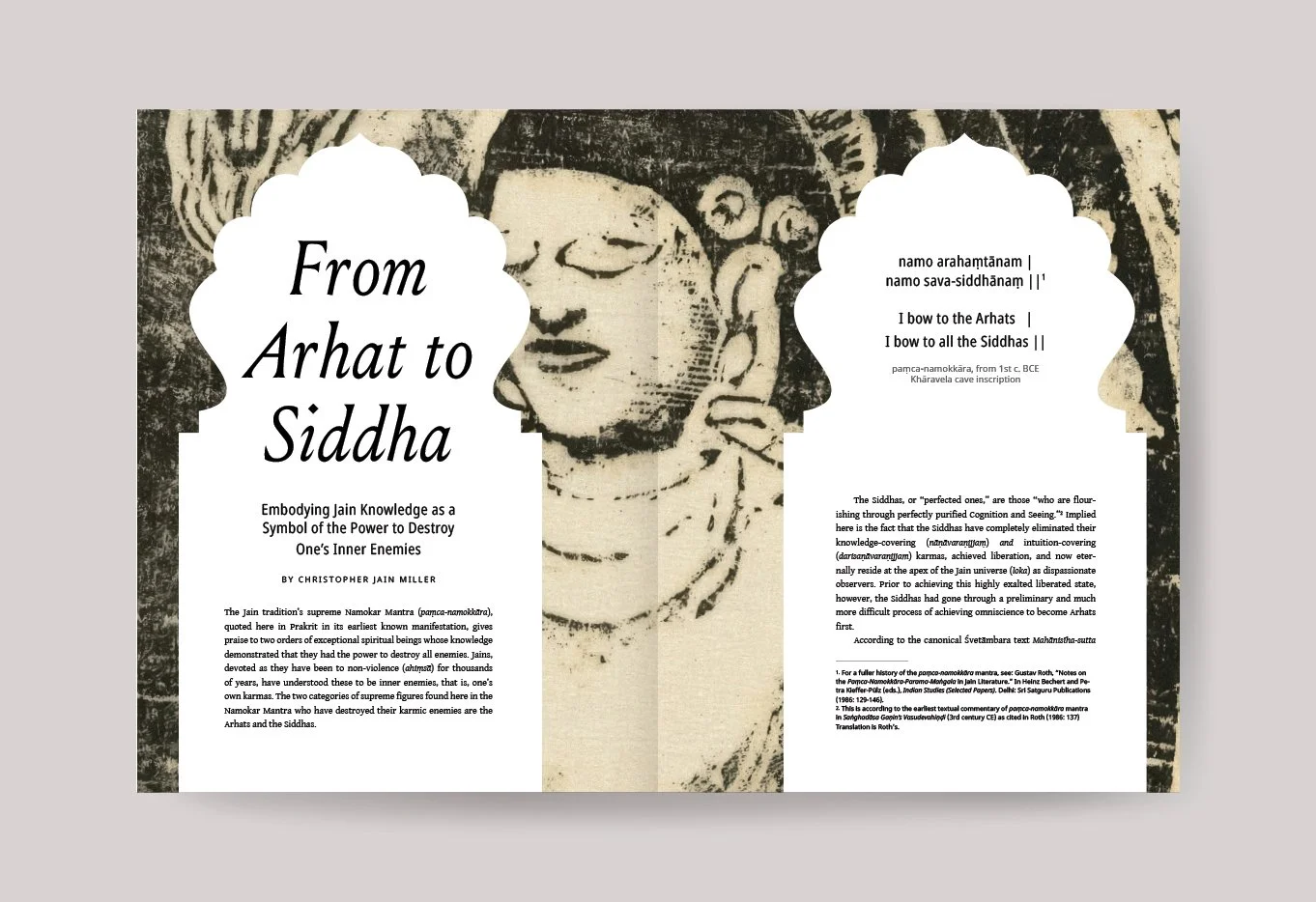
From Arhat to Siddha
It All Begins Here
Embodying Jain Knowledge as a Symbol of the Power to Destroy One's Inner Enemies
The Jain tradition’s supreme Namokar Mantra (paṃca-namokkāra), quoted here in Prakrit in its earliest known manifestation, gives praise to two orders of exceptional spiritual beings whose knowledge demonstrated that they had the power to destroy all enemies. Jains, devoted as they have been to non-violence (ahiṃsā̄) for thousands of years, have understood these to be inner enemies, that is, one’s own karmas. The two categories of supreme figures found here in the Namokar Mantra who have destroyed their karmic enemies are the Arhats and the Siddhas.
namo arahaṃtānam |
namo sava-siddhānaṃ ||
I bow to the Arhats |
I bow to all the Siddhas ||
The Siddhas, or “perfected ones,” are those “who are flourishing through perfectly purified Cognition and Seeing.” Implied here is the fact that the Siddhas have completely eliminated their knowledge-covering (nāṇāvaraṇijjaṃ) and intuition-covering (darisaṇāvaraṇijjam) karmas, achieved liberation, and now eternally reside at the apex of the Jain universe (loka) as dispassionate observers. Prior to achieving this highly exalted liberated state, however, the Siddhas had gone through a preliminary and much more difficult process of achieving omniscience to become Arhats first.
According to the canonical Śvetāmbara text Mahānisīha-sutta (7th century CE), the Arhats, or “those worthy of praise,” are those beings who are “within the whole world… full of omniscience” due to the fact that they have destroyed the “invincible enemy” of karma. Due to their ability to do so, the synonym “Jina,” from the Sanskrit verbal root √jī, “to conquer,” is also often used to describe the Arhats. In the Jain tradition, omniscience (kevala-jñāna) is indeed the penultimate step to liberation (mokṣa/parinirvāṇa). However, liberation is achieved only when an omniscient Arhat leaves the body at death. Before this final moment, however, he or she, having shown that it is possible to defeat the enemy of karma, remains in the world to dispassionately share Jain teachings with others so that they might achieve the same.
One of the keywords here is dispassionately, as Arhats have, through their austerities, amassed the power to eliminate all of their karma-attracting passions – the seemingly invincible enemies – including compassion, which keep us trapped in the cycle of rebirth and endless suffering. By embodying dispassion, the Arhats model the power necessary to achieve omniscience. This is not to say that compassion is not central to spiritual life in the Jain tradition, as compassion (kāruṇya) is promoted as the appropriate response for spiritual aspirants toward all beings they encounter who are in a state of distress (kliśyamāna), both human and non-human. Experiences of compassion are even often the experience that wakes people up to pursue the spiritual path according to the Jain tradition, such as when they see animals being sent for slaughter in the case of the Jina Neminātha or when they pay close enough attention to the desire of all beings to live, as observed by the Jina Mahāvīra. Ultimately, however, Jains recognize that attachments to feelings of any kind will cause karma and must eventually be completely abandoned to avoid rebirth.
Thus, before advancing to the final blessed state of becoming a Siddha, the Arhat remains fully – and yet dispassionately – engaged with the world until the end of his or her life. He or she disseminates the teachings of non-violence and dispassion and serves as the exemplary model around which the Jain community organizes itself, as each of its individual members works toward embodying the requisite knowledge and conduct necessary to achieve the same.
While embodying such a state that is “worthy of praise” (see above), the Arhat has nevertheless also fully relinquished attachment to exercising power. Thus, unlike yogic conceptions of supernatural powers, or siddhis, which are sometimes purposefully sought after by yogins for worldly gain, the Arhats, having eliminated the inner enemies that might tempt them to do the same, join, after their final earthly breath, the paṃca-namokkāra’s praise-worthy Siddhas eternally free from the karmic bondage effected by attachment to power.
According to Pūjyapāda’s Sarvārthasiddhi commentary on the canonical Tattvārtha Sūtra, we are currently in the fifth of sixth descending cosmic time cycles (avasarpiṇī) that began shortly after the liberation of Mahāvīra (6th-5th c. BCE) and during which the world is predicted to endure significant suffering. Pūjyapāda’s teachings here seem all too relevant, given the interconnected turmoil wrought by political violence, climate collapse, social injustice, animal agriculture, and biodiversity loss that we all collectively face today. All of these issues are undergirded by humanity’s abuse of power, the power that Foucault has shown us is everywhere. But this is also the same abusive human power that the Arhats, who are not predicted to appear again for thousands of years, are said to have nevertheless overcome ages ago.
Until the next ascending cosmic cycle (utsarpiṇī̄), we are left only with the Arhats’ enduring knowledge in Jain texts and in the few remaining embodied examples in the living Jain ascetic tradition in South Asia today. We also find special tribute to their knowledge etched in stone in the Khāravela caves where it has withstood the passing of more than two thousand years:
namo arahaṃtānam | namo sava-siddhānaṃ ||
I bow to the Arhats | I bow to all the Siddhas ||

Want to read more articles from Tarka Volume 9? Purchase On Power in print or digital from our online bookstore here.
Follow the Tarka Journal Substack for weekly articles straight to your inbox.
Inhabiting Power
It All Begins Here
Foucault, Identitarianism, and the Politics of Self-Cultivation
If you’ve spent any time in academia or in progressive political circles, you’ve probably heard the name “Foucault.” A charismatic thinker often cited when discussing questions of ‘power,’ Michel Foucault has acquired a sacred status in recent decades, joining the ranks of the Western philosophical canon. However, with canonization comes the tendency to compress a philosopher’s nuance into doctrine – transforming a body of work into something closer to a catechism than a corpus. In the case of Foucault, the ‘catechism’ that has emerged belies a recognizable political sensibility: one that finds oppressive power everywhere it looks — in institutions, language, bodies, and social norms — and that reflexively interprets virtually every human relationship through the lens of domination and subjugation.
Those who traffic in this sensibility will sometimes invoke Foucault’s authority as they simultaneously speak through a doctrine that was alien to him. Citing Foucault as a formative figure in their political awakening to ‘power structures,’ they reify an ideology that is unfaithful to what Foucault actually thought. As harbingers of a doctrine I refer to in this essay as identitarianism, they have become a consolidating force of intellectual and discursive power in their own right, blithely unaware of just how vulnerable their theory is to the destabilizing force of Foucault’s own thinking. What follows in this essay is less a refutation than a recognition – what is signified in the Sākta-Śaiva philosophy as pratyabhijñā. In the technical way this term is developed by the Kashmir Śaiva philosophers Utpaladeva and Abhinavagupta, I aim to highlight what was always already present in Foucault’s work, but which has been obscured by the conflation of his legacy with a contemporary doctrine.
Identitarianism is a contemporary ideology that frames all legitimate claims to political authority as matters of identity. In this framing, politics is progressive insofar as it strives toward the emancipation and inclusion of previously marginalized identities – a phenomenon often colloquially referred to as “identity politics.” Given this term’s recent appropriation by right-wing ideologues who have used it as a term of abuse against liberals and leftists, “identity politics” has become a potentially confusing and imprecise category; adding to the confusion, both left-wing and right-wing movements now traffic in their own respective forms of identity politics. I therefore opt for the less loaded term ‘identitarianism’ to refer to what underwrites the moral vocabulary and political doctrine that I analyze below.
While “identitarian” as a term has a long history that extends to the early half of the 20th century, the most politically sober version of its critique comes from thinkers who argue that, when the left organizes primarily around identity categories rather than class, it structurally accommodates neoliberalism rather than challenges it. The argument is that identity-based redistribution operates within, rather than against, existing modes of production. Political theorist Nancy Fraser specifically argued that political mobilization based on identitarian affirmation leads to surface redistribution — redistribution that does not challenge the status quo; a deconstruction of identitarianism rather than its affirmation is thus more conducive to goals of economic redistribution and justice.
The Phases of Foucault’s Philosophy
From the earliest period of Foucault’s corpus, he addressed – initially indirectly – the shifting norms that were instantiated in cultural institutions. His first book, Madness and Civilization, was an adaptation of his doctoral dissertation at the Sorbonne. Published in 1961, Foucault’s breakout contribution asked the questions: How did ‘madness’ become an object of knowledge? When did it become something to confine, classify, and treat? Rather than accepting ‘madness’ as a perennial psychological category or condition, Foucault traced the ways in which it hardened into a mode of identity – the “mad subject” – and was consolidated through what he refers to as the “Great Confinement.”
In 17th century European society, large numbers of people were newly confined to an emerging institution: the asylum. Groups affected by this institutionalization included the poor, the unemployed, the sexually ‘deviant,’ the criminal, and the mentally ill. Foucault aimed to demonstrate that this institutional marginalization was not rooted in a medical decision, but in a moral and economic one that effectively (re)structured the social order. The new social category of ‘madness’ was predicated upon conceptions of unreason, irrationality, idleness, and vice. What the “Great Confinement” reflected was therefore not so much a benevolent acknowledgment of ‘differences’ that necessitated specialized treatment, but a growing social consensus and institutional conformity around a particular conception of normality. Whatever identity or set of behavioral patterns did not fit this conceptual picture were deemed ‘abnormal.’ As such, they were seen as exhibiting symptoms of a ‘madness’ that society was suddenly compelled to ‘treat’ through a new ‘clinical gaze’ of medicalization, isolation, and scientific discipline. The irreverent and satirical ‘voice of madness’ that was previously represented in the Classical Age was later silenced during the Renaissance period.
While he referred to his first book as a “history” of madness, Foucault soon adopted the term “archeology” and then later “genealogy” to refer to his philosophical method — the latter being inspired by the 19th century German philosopher, Freidrich Nietzsche, and his work On the Genealogy of Morals. In what we’ll refer to as his “archaeological phase” of the 1960s, Foucault was concerned with discourse, implicit rules governing what counts as knowledge, and the historical conditions of possibility that permit various normative statements to arise – grounded in particular notions of ‘truth,’ ‘fact,’ and ‘common sense.’ During this period, he was not explicitly concerned with power relations, but rather with epistemes — the underlying structures that determine what can, must, or should be thought at any given time.
The 1970s marked the beginning of his subsequent “genealogical phase,” which introduced what the archaeological analysis had largely bracketed out: bodies, power relations, institutional practices, and the agonistic dimension of history. He shifted from an analysis of the conditions of discourse to an analysis of the effects of power. He asked questions regarding how socio-political systems emerge through conflict, contingency, and force. To summarize, if his ‘archaeology’ emphasized broader epistemic ruptures extending over long historical periods, his ‘genealogy’ emphasized accidents, struggles, and localized instances of ‘non-necessity’ – his goal being to show that what seemed inevitable was in fact contingent.
In the early 1980s, just prior to his death, he entered what is sometimes referred to as his ‘ethical phase.’ During this short period, something shifted in Foucault’s work. He became interested in disciplines of self-cultivation (askēsis), self-writing, care of the self, and ‘courageous truth-telling’ (parrhesia). He explored power not as something that institutions do to our bodies, but as something that individuals do with, for, and to themselves. The individual subject became a site of practice, a locus of stylization, and a participant in her own process of creative self-formation. While this does not make subjectivity entirely exempt from the effects of power relations and their constraining influence, nevertheless the individual became acknowledged, in these later works, as a unique site of empowerment.
This is an excerpt from a much longer essay. To read the full essay, get the new issue of “On Power” in Print or Digital.
Follow the Tarka Journal Substack for weekly articles straight to your inbox.
Representing Power
It All Begins Here
Devi in Indian Miniature Painting from Punjab Hills
Antecedents of Devī
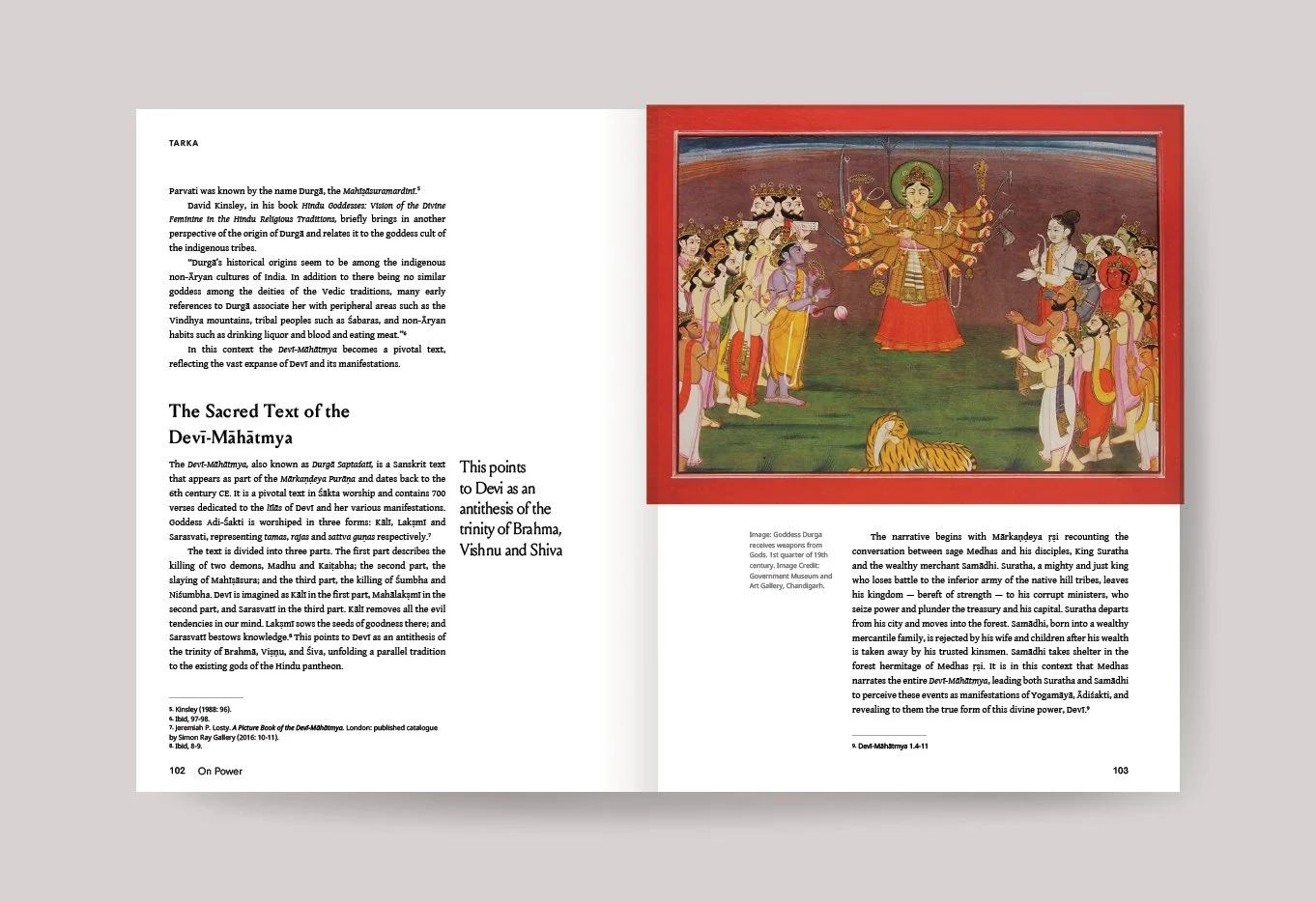
Devī is the supreme being in the Śākta traditions and the basis of tantra in Hinduism, Jainism and Buddhism. She is an embodiment of power that represents cosmic energy and is manifested in numerous forms. In Vivekananda’s words, “The Absolute is formless, but energy is female. When the energy takes form, it is called Mother. Mother is the moving power, disturbing into waves the water-calm of the Absolute.” The intertwining of Devī with the Absolute is presented as the union of Śiva and Śakti in Tantra, as puruṣa and prakṛti in Vedic traditions and as brahman and māyā in the Advaitic system. Devī, as the universal energy, is kuṇḍalinī, omnipotent, and once awakened she opens up the path of self-realization. This essay examines the visual representation of the Devī as goddess Durgā, the fierce one in the context of the sixth-century Sanskrit text of the Devī-Māhātmyam. A substantial text that consolidates the Devī cult in different regions of the subcontinent, the folio analyzed in the essay is from the Devī-Māhātmyam set, comprising 173 miniatures from the Kangra school, each 18 centimeters in height, and 26 centimeters in width. The work belongs to the Chandigarh Museum and is dated to the second half of the 18th century. It establishes Devī as an emblem of power and valour and gives insights into the imaginative vision of the Indian painter, to visualize the divine within the Indian miniature traditions of the hill regions of north India.
Within the plethora of Hindu Gods, Devī represents the feminine energy and becomes the central deity amalgamating various female goddesses already existing within diverse traditions. She encompasses the village goddesses worshiped in the Indian subcontinent as local female deities in folk traditions, or as Sarasvati, Usha, Aditi, Prithvi in the Vedic traditions. Devī has innumerable forms and names and yet retains her supreme place in the Hindu pantheon. She is referred to as Shakti (Śakti) or Durgā, one who fights with demons. While Shakti and Durgā are interchangeably used, Shakti refers to the power to annihilate the demons. Shakti manifests the inner force in the absence of which no action can be performed. It symbolizes the energy evoked by the Gods to restore the cosmic balance. On the contrary, one popular etymology of Durgā derives from durg, denoting ‘fortress’: a strong and powerful fortress that protects its inhabitants. According to David Kinsley, “Durga is inextricably associated with the physical world, the world she creates, sustains, and protects in her various forms.” This essay tries to relocate the presence of the Devī cult at the center of the Hindu pantheon, and suggests a contrasting point of view offered by Devī through her association with the feminine, thereby creating a space of her own within the dominance of the patriarchal cults of Viṣṇu and Śiva through her divine and fierce manifestations.
The visual presence of Devī as Durgā evokes an encounter with Vīra rasa in the minds of the adherent. Devī becomes a potent deity, meditating upon her arouses one’s latent power, leading to experiencing victory. Rasa literally means the ‘sap’ or the extract of plants. At a micro level it signifies the non material essence of a thing, and is causally related to bhāva – the ‘mood’ or emotional state of the viewer, audience, or the one who experiences. Bharata proposes eight such moods, each having a corresponding rasa. These are śṛṅgāra (the erotic), hāsya (the amusing), karuṇa (the compassionate), raudra (the furious), vīra (the heroic), bhāyanaka (the fearsome), bībhatsā (the odious) and adbhuta (the marvelous). Another rasa that was added to the list later is the śānta (the quiescent) completing the total to nine, known as the nava-rasas. Amongst all the nava-rasas that appropriates the visual depiction of Durgā in Devī-Māhātmyam is the vīra rasa. The Nāṭyaśāstra states that the vīra rasa relates to the superior type of persons and has excitement as its basis. Utsāha is the sthāyibhāva of vīra rasa referring to the heroic sentiment. The episode of Durgā slaying the buffalo demon Mahiṣāsura from the Devī-Māhātmyam, becomes one such performative moment evoking vīra rasa representations that can be seen across different visual styles of popular, calendar, folk and miniature art traditions.
It also brings focus to the presence of local chieftains of the Punjab hills and their conflicts for power amongst rivals. Devī miniatures from the region reveal the complexity of such relationships of patronage and its association with warrior cults of the northern hills. To conquer wars, one requires power and Devī - as embodiment of power - finds a prominent representation in these geographies demonstrating such territorial conflicts. From Rajasthan to Punjab hills, this control of power leads to the recurrence of Durgā in Indian painting traditions.
According to Vidya Dehejia, “as Jaganmata, or Mother of the universe, she assumes cosmic proportions, destroying evil and addressing herself to the creation and dissolution of the worlds.”
There are several mythological accounts of the origin of Durgā in the Purāṇic period. The Skanda Purāṇa relates that once upon a time a demon named Mahiṣa threatened the world. Śiva requested Parvati to slay the demon. Parvati then assumed the form of a warrior goddess and defeated the demon, who took the form of a buffalo. Thereafter, Parvati was known by the name Durgā, the Mahīṣāsuramardinī.
David Kinsley, in his book Hindu Goddesses: Vision of the Divine Feminine in the Hindu Religious Traditions, briefly brings in another perspective of the origin of Durgā and relates it to the goddess cult of the indigenous tribes.
“Durgā’s historical origins seem to be among the indigenous non-Āryan cultures of India. In addition to there being no similar goddess among the deities of the Vedic traditions, many early references to Durgā associate her with peripheral areas such as the Vindhya mountains, tribal peoples such as Śabaras, and non-Āryan habits such as drinking liquor and blood and eating meat.”
In this context the Devī-Māhātmya becomes a pivotal text, reflecting the vast expanse of Devī and its manifestations.
This is an excerpt from a longer essay. To read the full essay, get the new issue of “On Power” in Print or Digital.
Follow the Tarka Journal Substack for weekly articles straight to your inbox.